Most CAMA systems hard-code one jurisdiction's way of working into the software. OpenCAMA IQ runs your office on a single orchestration engine that administrators configure — states, gates, deadlines and routing — and that records every step for the day someone asks how a case got decided.
Inspection, valuation, exemptions, appeals and certification are not separate products bolted together — they are processes on one workflow engine, sharing the same data, audit trail and event backbone.
Schedule field reviews, route work to inspectors, track completion and feed findings straight back into valuation — no rekeying between systems.
Move values through analyst review, supervisor sign-off and statutory certification, with locks that prevent changes once a value is committed.
Application, approval, renewal and termination run as configurable stages — including the deadlines and reminders each program demands.
Intake, evidence assembly, hearing scheduling and decisions tracked end to end, so an appeals board sees the full history of a contested value.
Assemble, validate and certify the assessment roll on the same engine that produced the values — the final step in a continuous chain, not a separate export.
Because every process shares the platform, a single change — a parcel split, an ownership transfer — propagates to every workflow that touches it.
Workflows are authored by administrators as configuration — versioned, reviewable and changeable without a vendor release. Statutory deadlines change; your software shouldn't need a project to keep up.
Define the stages a case moves through and the exact conditions under which it may advance, branch or return.
Require sign-offs at the right points, and lock records against edits once a value or roll is certified.
Attach statutory and internal clocks to any stage, with escalations and reminders before a deadline slips.
Route work to the right person or team by jurisdiction, property class, workload or rule — automatically.
Every workflow definition is versioned, so you can see what the process was on any given date and why it changed.
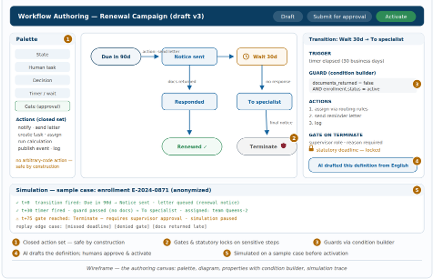
People still do the judgment. The platform makes sure the right item reaches the right person at the right time — and that nothing falls through the cracks.
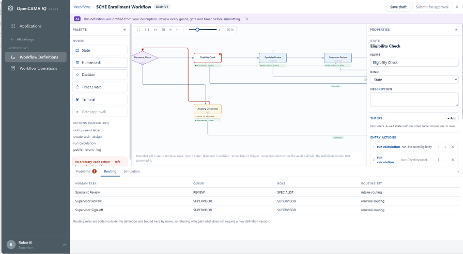
Components hand off through a reliable event backbone. A portal application becomes an exemption case; a certified value flows to the roll — automatically, in order, exactly once, and fully audited.
Events are processed in sequence, so downstream steps never run against stale or half-written state.
A retried or duplicated event produces the same result once — no double-created cases, no doubled credits.
Every hand-off is recorded with its source, payload and outcome, so you can trace a roll entry back to the application that started it.
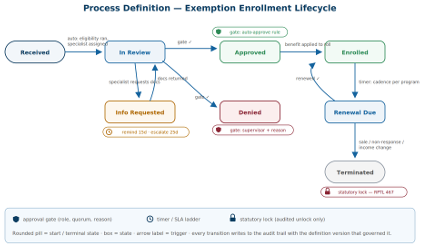
Processes ship as templates and adapt to each jurisdiction. There are no single-jurisdiction assumptions baked into the engine — so one platform serves a small township and a large county equally well.
Common processes — exemption intake, appeals, certification — arrive pre-built so you configure differences rather than starting from a blank page.
Tune stages, deadlines, gates and routing to local statute and practice, without forking the software for each office.
The engine makes no claim about how your office works. Multi-jurisdiction operators run distinct rules side by side on one deployment.
Every transition and approval is logged with who did it, what changed and when. When an appeals board or auditor asks how a case progressed, you can show them — step by step, with names and timestamps.
Related: Exemptions lifecycle · Valuation & certification · AI-assisted configuration.
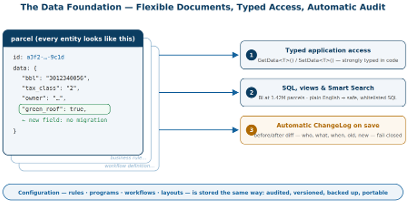
Bring the workflows you actually use — inspection, valuation, exemptions, appeals, certification — and we'll show you how OpenCAMA IQ configures them without locking you into anyone else's way of working.
Request a demo